ここから本文です
TWO:In the last chapter we dealt at length with the theories of art, and especially of tragic poetry, propounded in Aristotles Poetics. For the sake of formal completeness, it may be mentioned here that those theories are adapted to the general scheme of his systematic philosophy. The plot or plan of a work answers to the formal or rational element in Nature, and this is why Aristotle so immensely over-estimates its importance. And, just as in his moral philosophy, the ethical element, represented by character-drawing, is strictly subordinated to it. The centre of equilibrium is, however, not supplied by virtue, but by exact imitation of Nature, so that the characters must not deviate very far from mediocrity in the direction either of heroism or of wickedness.We have seen how Epicurus erected the senses into ultimate arbiters of truth. By so doing, however, he only pushed the old difficulty a step further back. Granting that our perceptions faithfully correspond to certain external images, how can we be sure that these images are themselves copies of a solid and permanent reality? And how are we to determine the validity of general notions representing not some single object but entire classes of objects? The second question may be most conveniently answered first. Epicurus holds that perception is only a finer sort of sensation. General notions are material images of a very delicate texture formed, apparently, on the principle of composition-photographs by the coalescence of many individual images thrown off from objects possessing a greater or less degree of resemblance to one another.186 Thought is produced by the contact of such images with the soul, itself, it will be remembered, a material substance.

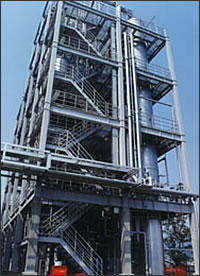
Distillation equipment01

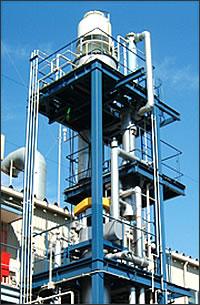
Distillation equipment02

THREE:Plutarch, who was twenty-one when Nero declared his country free, was the first leader in the great Hellenist revival, without, at the same time, entirely belonging to it. He cared more for the matter than for the form of antiquity, for the great deeds and greater thoughts of the past than for the words in which they were related and explained. Hence, by the awkwardness and heaviness of his style, he is more akin to the writers of the Alexandrian period than to his immediate successors. On the one side, he opens the era of classical idealism; on the other, he closes that of encyclopaedic erudition. The next generation bore much the same relation to Plutarch that the first Sophists bore to Hecataeus and Herodotus. Addressing themselves to popular audiences, they were obliged to study perspicuity and elegance of expression, at the risk, it is true, of verbosity and platitude. Such men were Dion Chrysostom, Her?des Atticus, Maximus Tyrius, and Aristeides. But the old models were imitated with more success by writers who lived more entirely in the past. Arrian reproduced the graceful simplicity270 of Xenophon in his narrative of the campaigns of Alexander and his reports of the lectures of Epicttus. Lucian composed dialogues ranking with the greatest masterpieces of lighter Attic literature. The felicity of his style and his complete emancipation from superstition may probably be traced to the same sourcea diligent study of the ancient classics. It is certain that neither as a writer nor as a critic does he represent the average educated taste of his own times. So far from giving polytheism its deathblow, as he was formerly imagined to have done, he only protested unavailingly against its restoration.
FORE:

Methanol refinement systems, amyl alcohol refinement systems, ethanol refinement systems, hexanol distillation systems, propanol refinement systems, cyclohexanol distillation systems, isopropanol dehydration systems, ethylene glycol recovery systems, and butanol distillation systems.

FORE:Hetty had no reply for the moment. That idea had never occurred to her before. Certainly she had never looked upon the Countess as a model mother; indeed, she had never seen her display what might be called natural affection.

Hexane distillation systems, tall oil distillation systems, benzene distillation systems, lubricating oil refinement systems, xylene-free distillation systems, low-boiling gas distillation systems, ethylbenzene recovery systems, fusel oil distillation systems, naphthalene distillation systems, propylene recovery systems, and turpentine oil distillation systems.

FORE:The main point in hardening and the most that can be done to avoid irregular contraction, is to apply the bath so that it will act first and strongest on the thickest parts. If a piece is tapering or in the form of a wedge, the thick end should enter the bath first; a cold chisel for instance that is wide enough to endanger cracking should be put into the bath with the head [116] downward.

Ether distillation systems, camphor distillation systems, epichlorohydrin distillation systems, aniline distillation systems, dioxane refinement systems, acetonitrile distillation systems, furfural refinement systems, formalin distillation systems, cyclohexane distillation systems, monoethanolamine rectification systems, polyglycol ether distillation systems, dimethylformamide recovery systems, acrylic glycol ether distillation systems, acrylonitrile refinement systems, acetone recovery systems, pyridine distillation systems, methyl ethyl ketone recovery systems, picoline distillation systems, methyl isobutyl ketone recovery systems, and acetaldehyde recovery systems.